

On this page, you can get access to a Julian calendar template for 2027 with all 365 days mapped out in a grid format. While the term ‘Julian date’ might mean different things elsewhere, on this page, we are specifically referring to the system of dating that numbers all the days of the year from 1 to 365. Since 2027 is a common year, the numbering on our calendar template stops at 365 rather than 366, which is associated with leap years that come up once every four years. Although this page doesn’t seek to dive into the historical context, it is still important to note that the Julian calendar is a system of dating that was first introduced in Ancient Rome around 46 BC by Julius Caesar.

Our Julian calendar template lets you reference any specific day of the year instantly. By assigning a continuous number to each day, it eliminates the need to manually count through the months. In practical terms, seeing day 243 immediately tells you it is August 31st (in a standard year). With a single glance, you can easily decipher both the month and the precise day of the year, or calculate exactly how many days are left by doing quick subtraction.
More 2027 Julian Calendar Templates
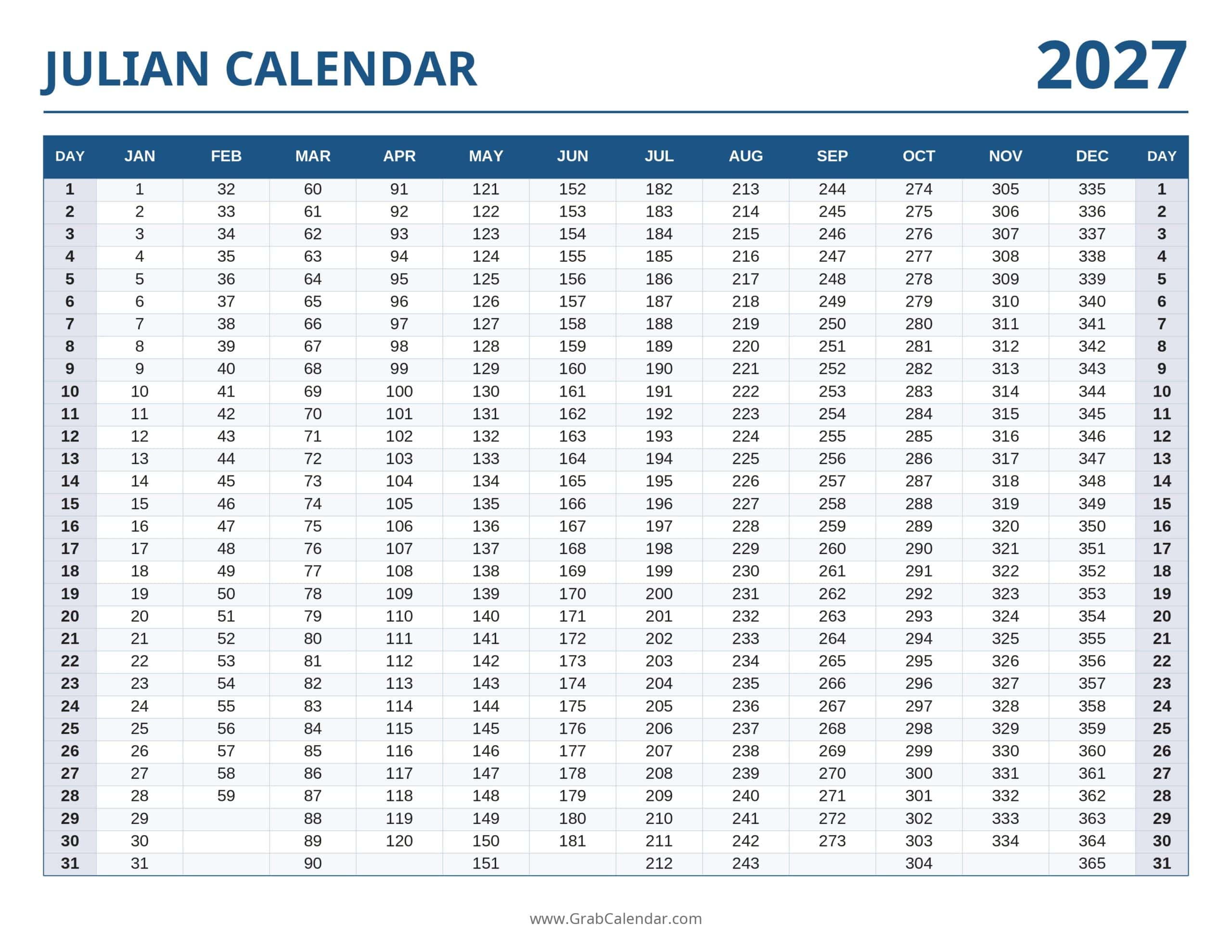
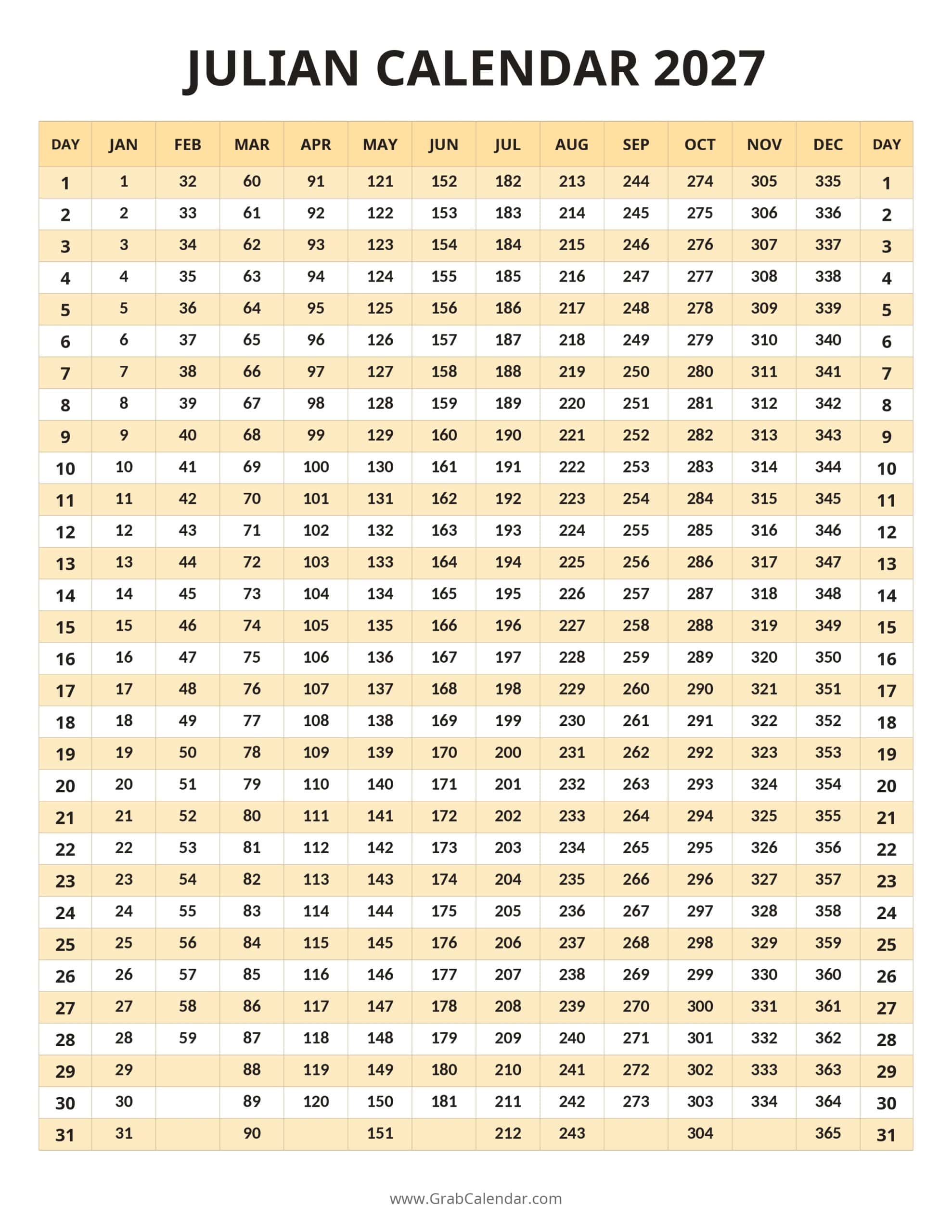
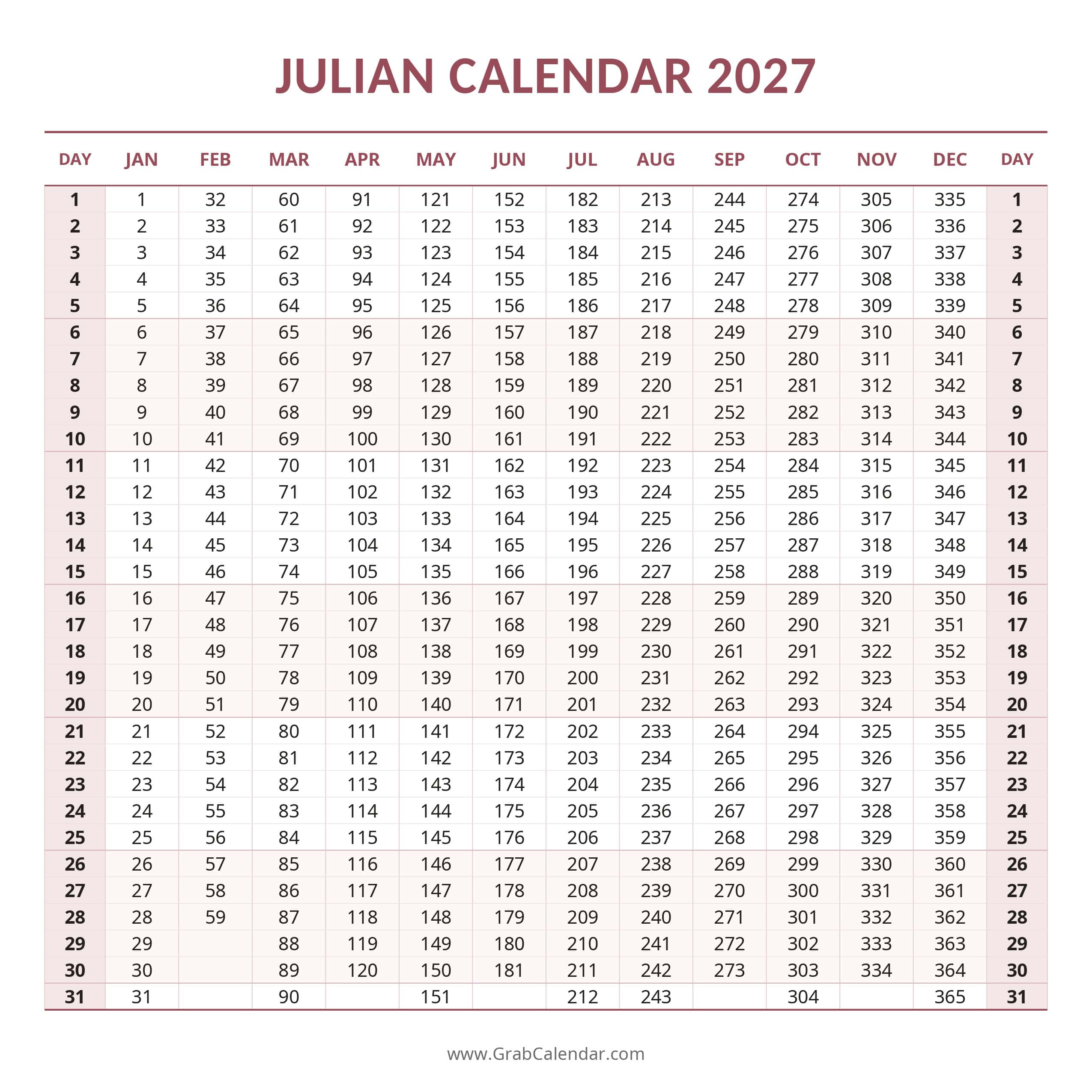
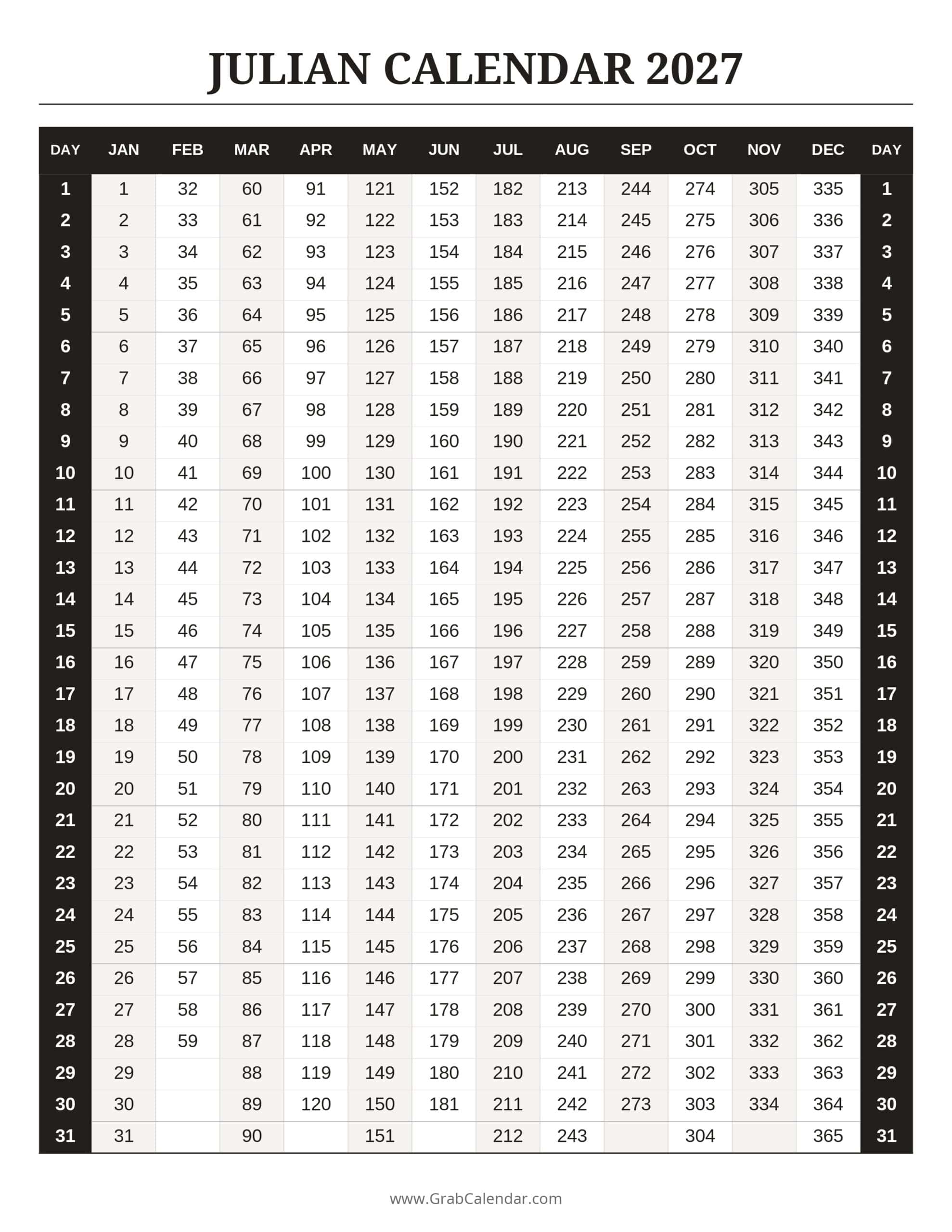
If you prefer a different look, we have also prepared 4 free printable Julian date calendars for 2027. Each template shows the days of the year from 1 to 365 together with the corresponding months, so you can quickly find the day number you need. You can choose the design you like, download it, and print it for easy reference throughout the year.
How to Read the 2027 Julian Calendar Template
Our Julian calendar template is divided into four quarters of the year. The first quarter, which spans from January to March, is colored in blue. The second quarter is colored in green to represent the period from April to June. Brown is the color used for the third quarter, which spans from July to September. The last quarter is colored with burgundy to mark the period between October and December.
To use our Julian calendar template accurately, start by picking a day’s number, then find the month it falls under by looking at the topmost row, where you’ll find all the months listed with their abbreviations. Once you have done that, you can trace the exact day of the month the number you have picked falls under by looking at the Day column colored in black. For example, by picking number 91 and looking at the month it falls under, you can tell it is the month of April. To determine what day of the month it is, simply take one more look at the day column. By doing this, you can instantly tell that number 91 represents the first day in the month of April.
The DAYS row at the bottom of the template represents the total number of days in each month. For instance, January has 31 days, February has 28 days, while April has 30 days. All these numbers are present in the DAYS row to give you a quick view of how many days are present in each month, and this explains the discrepancies between each number.
Quick Overview of Julian Dates for 2027
| Month-by-month day-of-year ranges for 2027 | |||
|---|---|---|---|
| Month | Days in month | First day number | Last day number |
| January | 31 | 001 | 031 |
| February | 28 | 032 | 059 |
| March | 31 | 060 | 090 |
| April | 30 | 091 | 120 |
| May | 31 | 121 | 151 |
| June | 30 | 152 | 181 |
| July | 31 | 182 | 212 |
| August | 31 | 213 | 243 |
| September | 30 | 244 | 273 |
| October | 31 | 274 | 304 |
| November | 30 | 305 | 334 |
| December | 31 | 335 | 365 |
Download and Print the 2027 Julian Date Calendar
To get access to a PDF version of our Julian calendar, click on the “Print it” button that appears under the template. This will open a PDF version in your browser that you can either print or download. A JPG version is also available. To access it, simply click on the image of the Julian calendar template. This will open a JPG version of the calendar that you can save on your device.
FAQ
Is this the same as the historical Julian calendar?
No, they are not the same. One refers to an historical system of dating that was first introduced in Ancient Rome around 46 BC by Julius Caesar. The Julian calendar template we provide aligns with the modern Gregorian dating system and simply numbers the days from 1 to 365 for reference.
What happens with a leap year?
In a leap year, the number of days in a year extends from 365 to 366 days because an extra day is added to the days in the year. A Julian calendar template for a leap year would read from 1 to 366. This is often reflected in February, which ordinarily has 28 days but becomes 29 days in a leap year.
Is this different from an astronomical Julian Date?
Yes. The astronomical Julian date is a separate type of day-count system that is often used in scientific contexts. It counts from a fixed historical reference point rather than starting from January 1, when the year restarts. Our Julian calendar template simply lists the days within the year 2027 starting from January 1. If you want to convert a calendar date to an astronomical Julian Date, you can use the U.S. Naval Observatory’s Julian Date converter.
Looking for a Standard Calendar Instead?
If you are looking for a standard calendar instead of the day-of-the-year format, you can check out our monthly calendars. You can also check out our 2027 yearly calendar, which follows the standard format if you are looking for a yearly calendar with all the days and dates of the year in one grid layout.